Message Queues - System Design
Message Queues: Enabling Asynchronous Communication and Loose Coupling in Distributed Systems
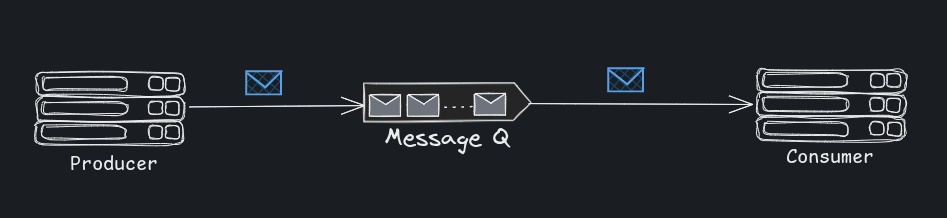
Message queues play a crucial role in enabling asynchronous communication between different components of a distributed system. They act as an intermediary layer between producers and consumers, temporarily storing messages until they are ready to be processed.
By introducing this layer of abstraction, message queues help achieve loose coupling between services, allowing producers to publish messages without waiting for consumers to process them. This enables both sides to operate independently, handle varying workloads, and scale at their own pace without directly affecting each other's performance.
Example: In a video streaming platform, when a user uploads a video, the upload service can publish a message to a queue. Background workers can then handle video transcoding, thumbnail generation, and metadata extraction asynchronously without making the user wait for all processing tasks to complete.
Message Structure
A message in a message queue typically consists of two logical components, each serving a distinct purpose:
- Headers / Metadata: Contains information used to identify, track, and route the message. Common fields include a unique message ID, timestamp, content type, routing information, and correlation ID.
- Body / Payload: Contains the actual data or instruction being transmitted. Depending on the use case, the payload can be in formats such as JSON, plain text, binary data, or serialized objects.
Components of a message queue
A message queue architecture typically consists of the following four components:
- Message Producer: The application or service responsible for creating and publishing messages to the queue. It initiates communication by sending messages containing data or instructions that need to be processed.
- Message Queue: Acts as an intermediary storage layer that temporarily holds messages until they are retrieved and processed by consumers. It also serves as a buffer, helping manage differences in processing speeds between producers and consumers.
- Message Consumer: The application or service responsible for retrieving messages from the queue and executing the corresponding processing logic. Consumers can process messages independently of the producers.
- Message Broker (Optional): A middleware component that manages message routing, delivery, and storage. It coordinates communication between producers and consumers and may provide additional capabilities such as acknowledgments, retries, and message persistence.
How Does a Message Queue Work?
The message queue follows a producer-consumer communication model, where messages are published, temporarily stored, and processed asynchronously. The overall workflow consists of the following steps:\
- Message Publishing: The producer creates a message containing the required data or instructions and publishes it to the message queue.
- Message Storage: Once received, the queue temporarily stores the message until it is delivered to a consumer. Message ordering depends on the queue's implementation and configuration.
- Message Consumption: Consumers retrieve messages from the queue and process them independently of the producers. Multiple consumers can work concurrently, allowing the system to handle higher workloads.
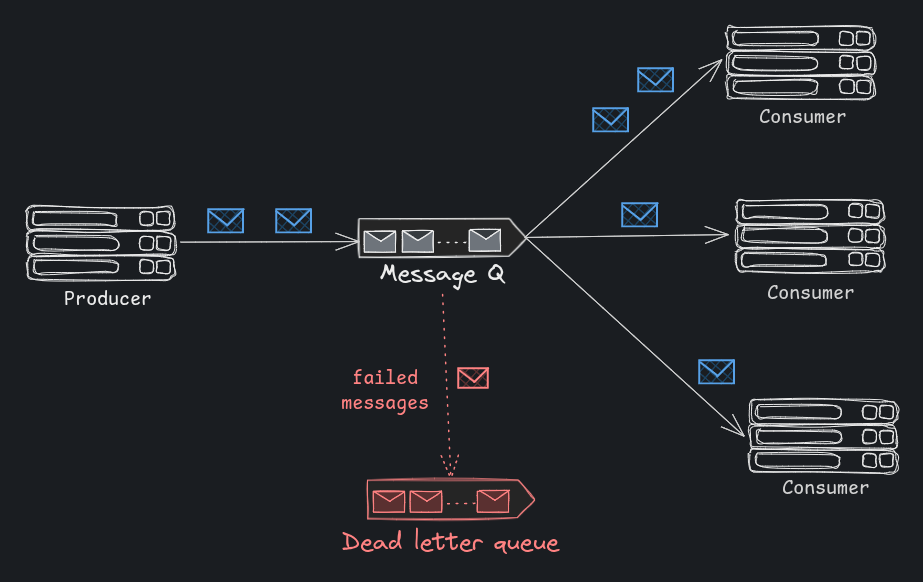
- Acknowledgement (ACK): After successfully processing a message, the consumer sends an acknowledgement to confirm completion. If a message remains unacknowledged, the broker may retry its delivery or make it available for another consumer, depending on its configuration.
Why Are Message Queues Important?
Message queues play an important role in building scalable, reliable, and loosely coupled distributed systems. Their key benefits include:
- Asynchronous Communication: Allows producers to publish messages without waiting for consumers to complete their processing. This improves application responsiveness and prevents time-consuming background tasks from blocking the main execution flow.
- Decoupling: Separates producers from consumers, enabling applications and services to operate independently. Changes in one component have minimal impact on others, making the system easier to maintain, extend, and evolve.
- Scalability: Enables workloads to be distributed across multiple consumers. As message volume increases, additional consumers can be introduced to improve processing throughput and handle higher workloads.
- Reliability: Provides mechanisms such as message persistence, acknowledgements, automatic retries, and Dead Letter Queues (DLQs) to handle processing failures and reduce the risk of message loss.
Messaging Models
Messaging systems generally follow two primary communication models: Point-to-Point and Publish-Subscribe. Each model defines how messages are distributed between producers and consumers.
1. Point-to-Point Messaging
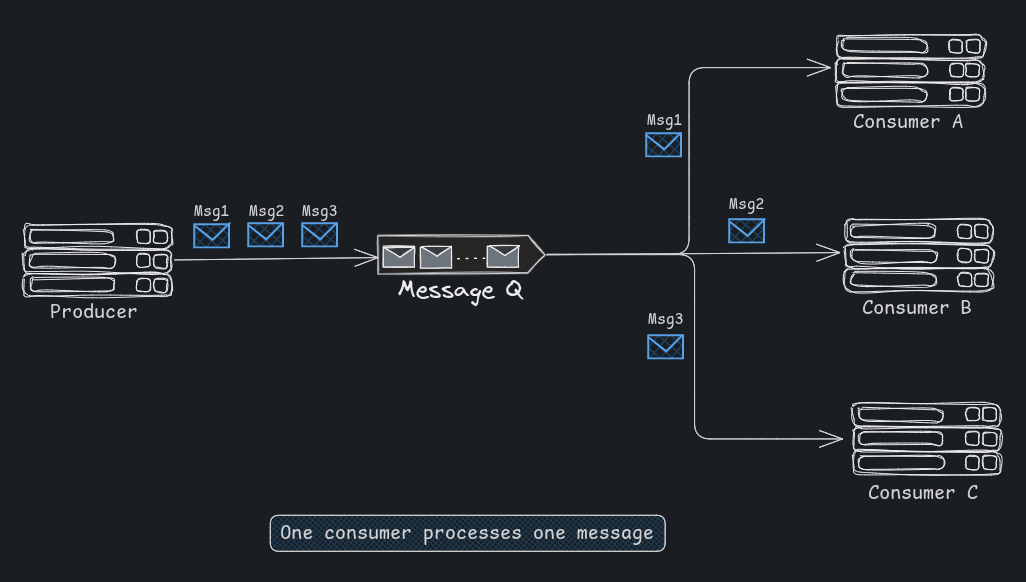
In the Point-to-Point messaging model, producers publish messages to a queue, and multiple consumers compete to retrieve and process those messages. Each message is typically delivered to only one consumer, ensuring that the same message is not independently processed by multiple consumers under normal queue semantics.
This model is particularly useful when distributing workloads across multiple workers. Instead of assigning every task to a single consumer, the queue distributes available messages among workers, allowing them to process tasks concurrently and improve overall throughput.
Example:
Consider a background job processing system with three workers:
- Worker A: Retrieves and processes Message 1.
- Worker B: Retrieves and processes Message 2.
- Worker C: Retrieves and processes Message 3. Each worker processes its assigned message independently. Once processing is complete, it acknowledges the message so that the queue can remove it.
Common Use Cases:
- Background job processing.
- Order and payment processing.
- Image and video processing.
- Email and notification delivery.
- Report generation and data processing.
1. Publish-Subscribe (Pub-Sub) Messaging
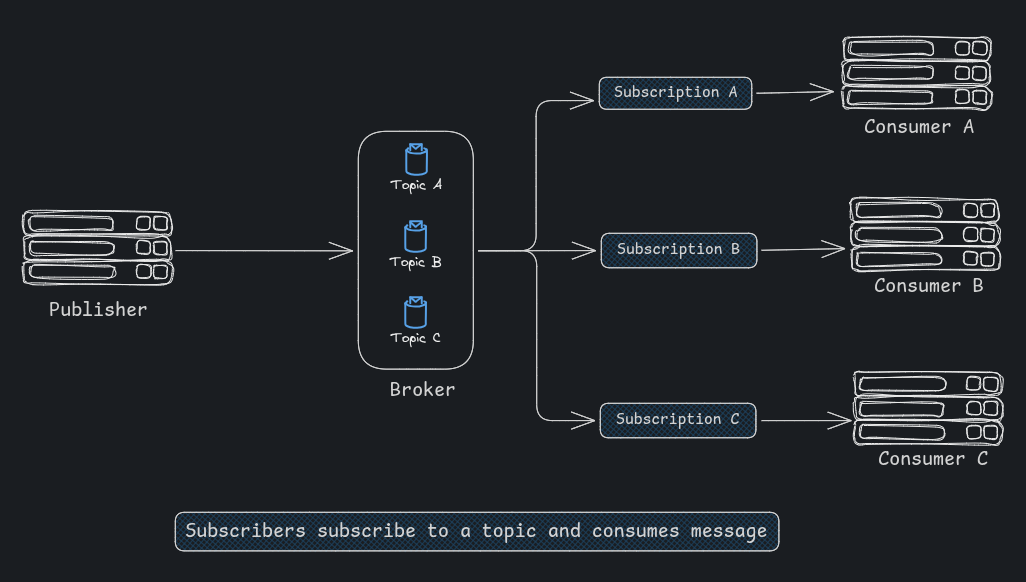
The Publish-Subscribe messaging model enables one-to-many communication between publishers and subscribers. Unlike the Point-to-Point model, where a message is typically consumed by a single consumer, Pub/Sub allows multiple independent subscribers to receive the same message.
In this model, publishers send messages (events) to a topic or channel rather than directly targeting individual consumers. The messaging system then distributes a copy of the published message to each subscriber associated with that topic.
This approach promotes loose coupling because publishers do not need to know which services are subscribed to their events or how those services process them.
Example:
Consider an order management system where an OrderPlaced event is published to an orders topic. Multiple services subscribe to this topic and independently perform their respective operations:
- Inventory Service: Updates stock availability based on the newly placed order.
- Notification Service: Sends an order confirmation to the customer.
- Analytics Service: Records order-related data for reporting and business insights. All three services receive the same event and process it independently without directly communicating with the order service.
Common Use Cases:
- Event-driven architectures.
- Real-time notifications and updates.
- Analytics and data processing pipelines.
- Audit logging and event tracking.
- Event streaming and monitoring.
Key Characteristic: A single published event can be delivered to multiple independent subscribers, allowing different services to react to the same event without being tightly coupled to one another.
Scalability in Message Queues
Scalability is an important aspect of message queue systems, especially when handling high message volumes and increasing workloads. As the number of incoming messages grows, message queue architectures provide several mechanisms to distribute workloads, increase processing capacity, and maintain system performance.
The three common approaches to scaling message queue systems are:
- Consumer Scaling: Involves adding multiple consumers or worker instances to process messages concurrently. Instead of relying on a single consumer, workloads are distributed across multiple consumers, increasing processing throughput and reducing message processing delays.
- Partitioning: Divides a topic or queue into multiple partitions, allowing messages to be distributed across different processing units. Each partition can be processed independently, enabling parallel consumption and better workload distribution. This approach is commonly used in distributed messaging systems such as Apache Kafka.
- Broker Scaling: Involves adding more broker nodes to a distributed messaging infrastructure. Multiple brokers distribute message storage and processing responsibilities, helping increase overall throughput, storage capacity, fault tolerance, and availability.
Reliability and Failure Handling
Reliability is a critical aspect of message queue systems, particularly in distributed environments where network failures, consumer crashes, and processing errors can occur unexpectedly.
To ensure reliable message delivery and prevent failed messages from disrupting normal operations, message queue systems provide several failure-handling mechanisms:
- Acknowledgments (ACKs): Allow consumers to confirm that a message has been successfully processed. Once the broker receives an acknowledgment, the message can be removed from the queue. If a consumer fails before acknowledging a message, the broker may make it available for redelivery or retry, depending on its configuration.
- Dead Letter Queue (DLQ): Acts as a separate queue for storing messages that repeatedly fail processing after exhausting their configured retry attempts. Instead of allowing problematic messages to continuously block normal processing, the system moves them to the DLQ for debugging, investigation, and potential reprocessing.
- Message Prioritization: Allows messages to be assigned different priority levels so that higher-priority messages can be processed before lower-priority ones. This helps ensure that critical tasks receive attention earlier. However, priority-based processing may affect First-In, First-Out (FIFO) ordering.
Conclusion: Key Takeaways
Message queues are a fundamental building block of modern distributed systems, enabling asynchronous communication, loose coupling, and efficient workload distribution between independent services.
By introducing an intermediary layer between producers and consumers, they allow applications to process tasks independently without blocking the main execution flow. As systems grow, features such as consumer scaling, partitioning, and distributed brokers help handle increasing workloads while maintaining performance.
However, building a reliable messaging system requires more than simply placing messages into a queue. Mechanisms such as acknowledgments, message persistence, retries, and Dead Letter Queues (DLQs) play an important role in handling failures and ensuring reliable message processing.
Key Takeaways:
- Asynchronous Communication: Producers and consumers can operate independently without waiting for each other's execution.
- Loose Coupling: Services communicate through messages rather than depending on direct interactions.
- Scalability: Multiple consumers, partitions, and broker nodes help distribute workloads and increase processing capacity.
- Reliability: Acknowledgments, retries, persistence, and DLQs help manage failures and prevent message loss.
- Messaging Models: Point-to-Point supports one-consumer-per-message processing, while Publish-Subscribe enables multiple subscribers to react to the same event.
Ultimately, message queues help developers build systems that are more scalable, resilient, and maintainable. Understanding their working principles, messaging models, scalability strategies, and failure-handling mechanisms is essential when designing distributed systems that need to handle workloads reliably at scale.
References
Comments
Join the discussionNo comments yet. Be the first to comment.